Five Interesting Facts About Ottó Tolnai,
whose works are now being introduced to thousands of high school students thanks to Libri
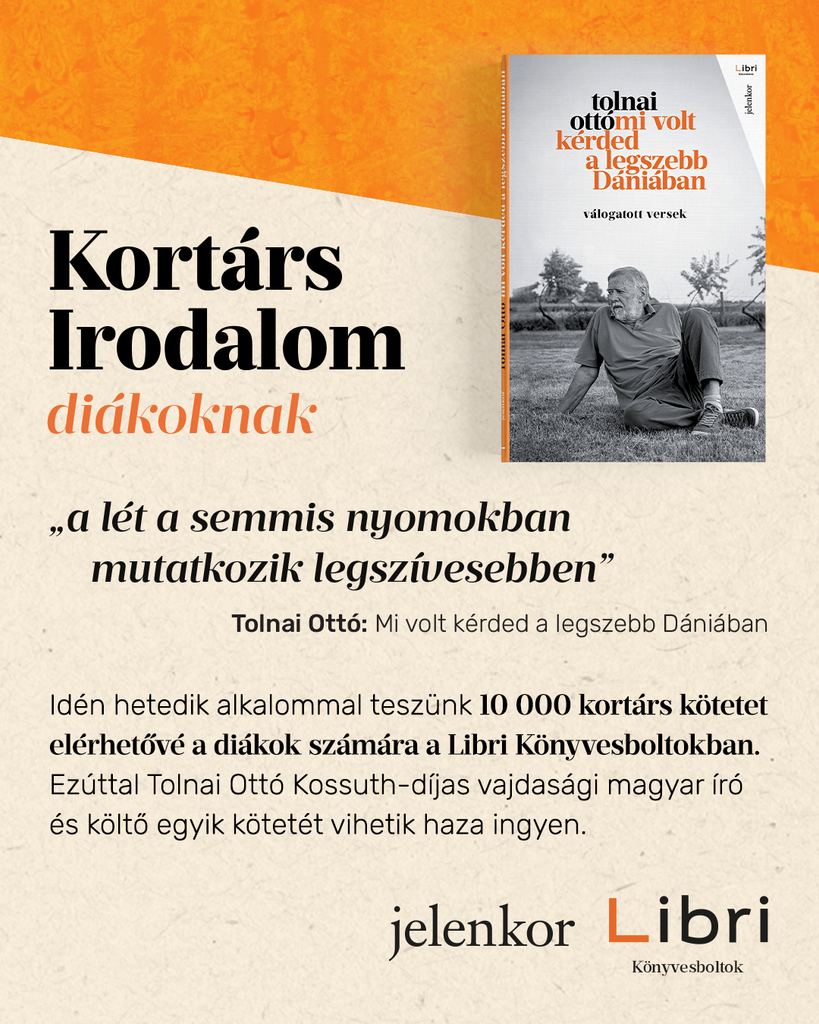
Libri hopes to bring one of Hungarian literature’s most original authors closer to young people by distributing 10,000 free copies of Ottó Tolnai’s books. The anthology Mi volt kérded a legszebb Dániában, published by Jelenkor Publishing, is the latest addition to a book donation program that has been running since 2021, through which tens of thousands of free books have reached students in recent years. Previously, the program has made the works of Miklós Mészöly, Ágnes Nemes Nagy, Péter Nádas, Szilárd Borbély, and János Térey, among others, available for free. But who was Ottó Tolnai, and why might his poetry be of interest even to young people encountering his name for the first time?
In the history of Hungarian literature, there are writers whose names are known to almost everyone, and there are others whose bodies of work are influential, yet about whom we know less. Ottó Tolnai belongs to the latter group. One of the most important figures in Hungarian literature from Vojvodina, he created a unique, playful, and often surprising world; in his poetry and prose, even the most seemingly insignificant everyday objects, memories, and moments could give rise to literature.
Libri and Jelenkor Publishing now want to make this world accessible to high school students as well. And to do that, you don’t necessarily need knowledge of literary history—just curiosity.
Five Things You Might Not Know About Ottó Tolnai
1. He entered the world of literature while still in high school
Ottó Tolnai was born in Magyarkanizsa in 1940 and turned to writing at a young age. His first publications date back to his high school years. In other words, the author whose works are now read by thousands of high school students began to find his own voice at a similar age. Later, he created one of the most distinctive poetic worlds in Hungarian literature.
2. A single magazine influenced an entire literary generation
The name Ottó Tolnai is inextricably linked to Új Symposion, the literary and arts journal based in Novi Sad that became one of the most exciting hubs of Hungarian cultural life in Vojvodina during the 1960s and 1970s. As the journal’s editor, he championed a creative approach that was open to experimentation, contemporary arts, and new forms of expression. Új Symposion was not merely a literary journal; it also shaped the thinking and artistic quest for freedom of a new generation.
3. He even clashed with the authorities in his fight for literary freedom
The political conflicts surrounding Új Symposion also influenced Ottó Tolnai’s career. In the course of his editorial work, he came to realize that literary freedom is not a given, and that artistic experimentation can have political consequences. He was forced to step down from his position at the magazine, but he continued his creative work. His story also serves as a reminder that literature is not merely a collection of stories and poems: it can also be a form of free thought.
4. He was just as interested in the visual arts as he was in literature
Ottó Tolnai was not only a poet and prose writer, but also had a passionate interest in the visual arts; in his writings, painting, the world of objects, and literature often intersect. For him, art did not consist of separate genres, but of worlds in constant dialogue with one another. This is why his texts may be of interest to those who engage with culture not necessarily through poetry, but through music, film, or the visual arts.
5. For him, almost anything could be poetry
One of the most distinctive features of Ottó Tolnai’s poetry is that he did not necessarily seek out major historical events or lofty themes. An everyday object, a color, a small memory, or a seemingly insignificant observation could set in motion an entire world of thought for him. In his writings, unexpected associations, personal memories, and peculiar images intertwine. Perhaps this is precisely why it’s worth discovering his work at a young age. He shows that literature isn’t just about what we’ve been taught is important, but also about what we ourselves notice in the world.
From Mészöly to Tolnai: Tens of Thousands of Free Books for Young People
The Ottó Tolnai volume is part of a long-term initiative. Since 2021, Libri and Jelenkor Publishing have been striving to engage young readers with anthologies that offer a taste of the works of influential figures in Hungarian literature.
The series began with Miklós Mészöly’s volume Nem felelt meg neki, and continued with Ágnes Nemes Nagy’s Szilánkos fényjelek, Péter Nádas’s Berlini szürke, Szilárd Borbély’s Egyre rövidebb szavak, and János Térey’s anthology Árnyékunk útra vált. In 2025, the program featured the publication of András Visky’s Vissza a nyomokon; this year, the focus has shifted to the poetry of Ottó Tolnai.
The goal of the initiative is not simply to donate books, but to enable young people to establish personal connections with authors whose works are an important part of Hungarian culture, even though they are not necessarily among the most frequently chosen reads.
“Promoting reading doesn’t just mean putting books into the hands of young people that they’d be happy to read anyway. It’s just as important that they encounter authors and stories that open up new worlds for them. That’s why we’ve been working with Jelenkor Publishing for years: we want the leading figures of Hungarian literature to be present in the lives of the next generation not only as part of the school curriculum but also as a personal reading experience. Ottó Tolnai’s unique, playful, and free-spirited poetry offers an excellent opportunity for this,” said Ákos Zulik, deputy CEO of Libri.
Ten Thousand Opportunities for a New Reading Experience
Ten thousand copies of the anthology Mi volt kérded a legszebb Dániában? are intended for high school students. The initiative is based on the realization that, when discovering an author, the first encounter is often the most important moment. If a book is made available for free, it can reach young people who might not otherwise pick it up from a bookstore shelf.
What makes Ottó Tolnai’s works so special is precisely that they offer more than one way to read them. Some readers may be drawn in by the humor, others by the unusual imagery, and still others by the freedom of the texts. Libri’s initiative creates an opportunity for 10,000 young people to discover for themselves what this literary world means to them.
The book Mi volt kérded a legszebb Dániában is available at Libri bookstores while supplies last, upon presentation of a valid student ID, with no purchase required.