A month after the start of preschool and school, daily life in many families still revolves around adjusting to the new routine. Some children make it clear when the new environment is too much for them, while others try to fit in all day long and only let their tension out once they’re home. How can we tell if a child has truly found their place? And who should adapt: the child, the parent, or the community? Psychologist Zsófia Záborszky and Petra Zsirai, authors of the children’s book Megjöttünk!, draw on their own experiences as mothers to discuss how we can help children while gaining a better understanding of them.

October, as ADHD Awareness Month—and especially October 10, the globally recognized World Mental Health Day—is a great opportunity to talk about children’s mental well-being. With the start of the school year in the fall, the question is particularly timely: what do we consider successful integration? Is it enough for a child to sit quietly, follow the rules, and not be the subject of any complaints? First-time authors discovered through the Libri Talent Mini children’s book writing contest drew attention to the fact—during a roundtable discussion at the Budapest International Book Festival—that very different experiences may lie behind observable behavior.
There’s a story behind the behavior
A major turning point for Petra Zsirai came when, instead of comparing her child to others and blaming herself, she began observing her own child. She sought to understand under what circumstances her child felt comfortable and in which situations the events around her became too overwhelming. A noisy environment, many new faces, or unexpected changes can be stressful even for two children of the same age.
“There’s a lot we can do for our well-being if we pay attention to the environment our child is in and how they’re feeling,” says Petra Zsirai. “This can also help parents avoid seeing difficult moments as proof of their own inadequacy, but rather as a sign worth investigating.”
Zsófia Záborszky also speaks from her own experience: “Behavior is always just the tip of the iceberg. Behind the yelling, there may be hunger, fatigue, too many activities, or a conflict experienced within a community. The child’s unique neurological functioning may also be part of the picture, but it’s not worth drawing conclusions from a single reaction. It’s more important to observe recurring patterns, the circumstances, and whether any changes have occurred in the child’s life.”
Even those who don’t bother others may need help
The difficulties faced by a reserved, quiet child in a group setting are more likely to go unnoticed. Based on her own experience, Petra Zsirai notes that a child may try to hide their anxiety during the day but can no longer hold it in once they get home. In such cases, the parent sees a side of the child that the teacher may not be aware of at all.
That’s why, in addition to feedback like “there was nothing wrong with him,” it also matters how he starts his day, how tired he gets, and what condition he’s in when he comes home. An afternoon meltdown alone doesn’t explain what happened, but it can be a good starting point for brainstorming together. It’s worth talking to the teacher about specific situations: when the child withdraws, what causes them to become tense, and what helps them reconnect with the others.
In addition to acceptance, borders also provide a foothold
“In addition to understanding how a child functions, we must also teach the rules of living together in a community. Part of emotional security is a predictable framework in which adults accept emotions but put a stop to hurtful behavior,” emphasizes Zsófia Záborszky. “I can see that you’re angry, but that doesn’t mean we hit others. As a psychologist, this is the approach I usually recommend.”A connection doesn’t always require a long explanation: it can mean a lot just for a child to feel that an adult has noticed what’s difficult for them. It’s just as important to acknowledge their effort when they manage to cope with a situation that’s stressful for them.”
According to the authors, even small changes can provide a point of support. A quiet corner where a child can retreat for a short time, a break from activity, or a personalized supportive task can make it easier for the child to participate in group settings. At home, it’s also worth observing whether, after coming home, the child needs conversation, physical activity, or quiet time. Instead of shaming them or comparing them to other children, focus on their own needs and development.
A story can help you find the right words
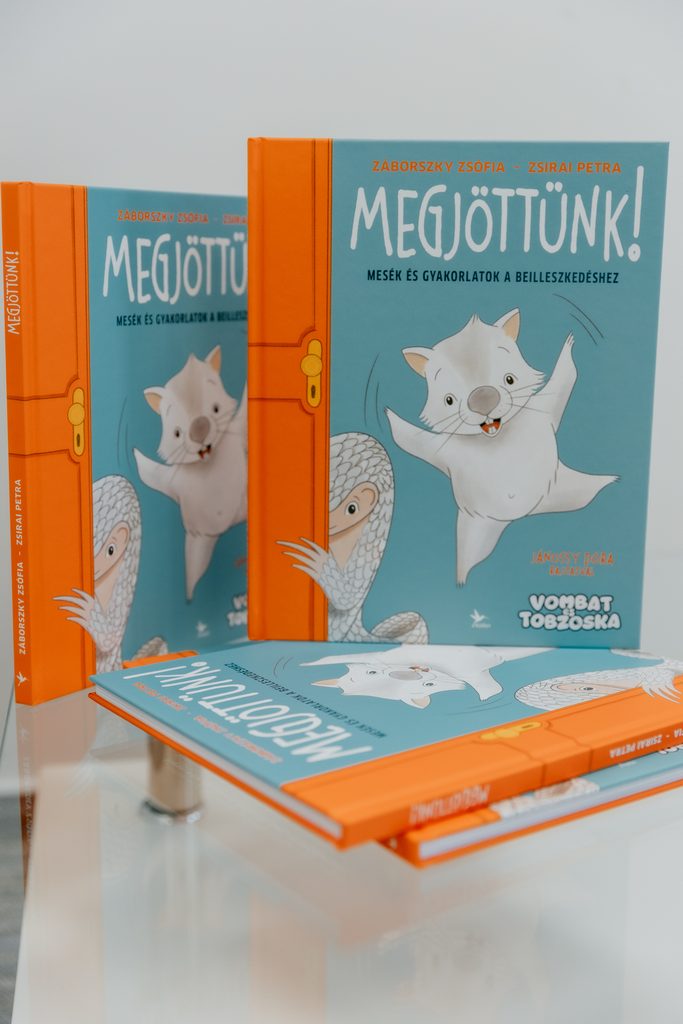
It’s not always easy for children to express what’s going on inside them. However, through the story of a fairy-tale character, they can get closer to their own feelings. Drawing on this experience, Zsófia Záborszky and Petra Zsirai created the world of Vombat and Tobzoska: the two characters, who function in different ways, are finding their place in the new Tanodú community, while Tapír Mester helps them through difficult situations.
“We wanted everyone to be able to identify with a character in the story and realize that whatever they’re struggling with isn’t just their story,” says Petra Zsirai. “It’s no coincidence that the characters are endearing animals; we intentionally didn’t give them human names or diagnostic labels, nor did we specify whether they’re boys or girls, preschoolers or schoolchildren—the focus is on familiar situations and the different ways people experience them.”
The book Megjöttünk! – Mesék és gyakorlatok a beilleszkedéshez, published by Kolibri Children’s Book Publishing, features three stories supplemented by a professional guide for parents and educators, discussion-starting questions, and relaxation audio recordings accessible via QR codes. The stories also describe the physical sensations children experience: what it feels like when your throat tightens or your stomach tingles strangely. This way, reading together can spark a conversation about what the child has experienced in their own day.